Clams
Two clams rule the New England table: the thick-shelled quahog and the brittle-shelled steamer. Knowing which is which — and which size does what — is half of clam cookery.
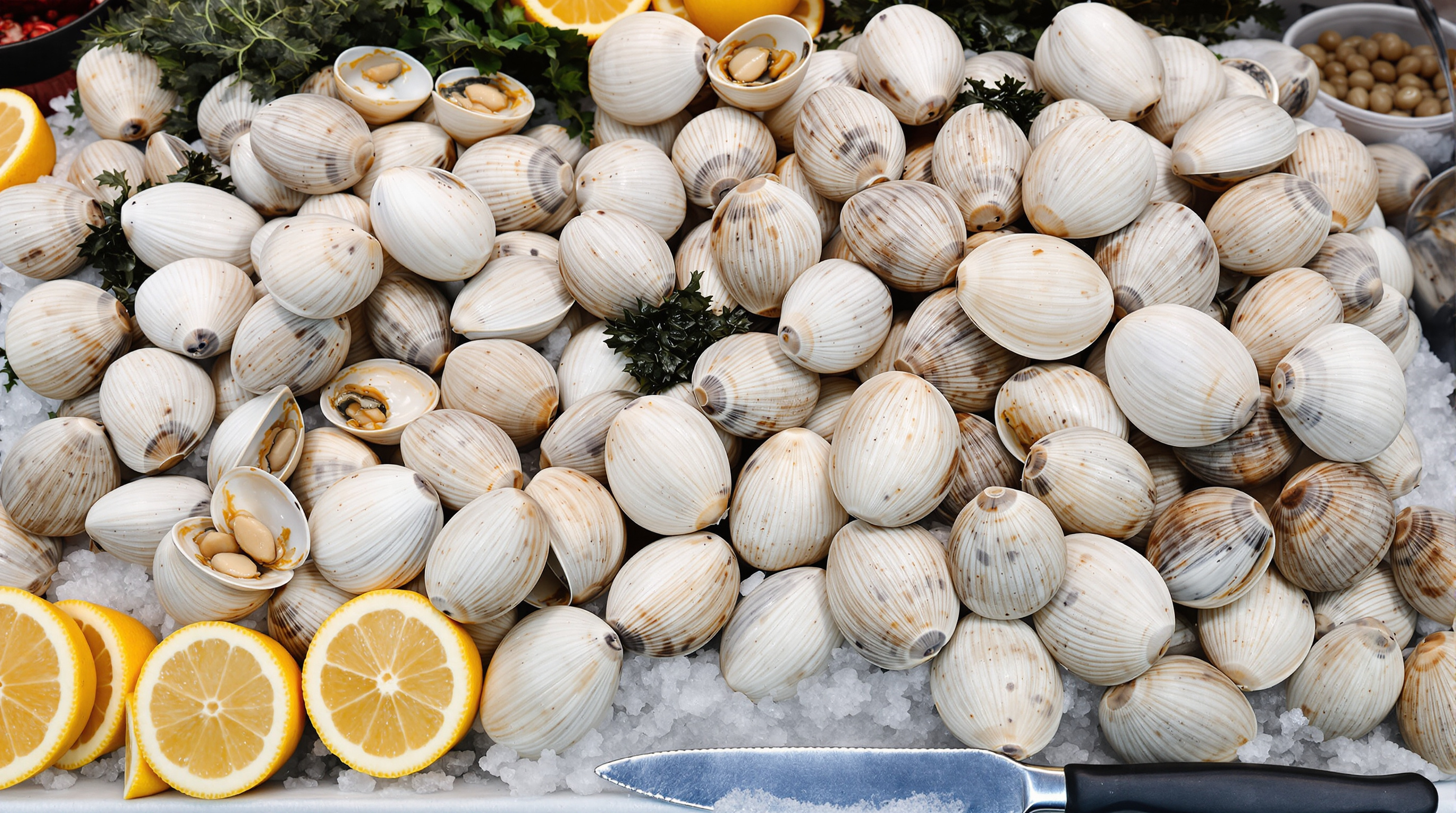
Hard-Shell Clams (Quahogs)
Also called the quahog, the hard clam grows to about four inches across with a thick, grayish-white shell, white inside with a purple patch near the rear — shells whose purple wampum was once a currency among coastal Native peoples. Quahogs live in sandy-bottomed bays and coves from Canada to Texas, though only sporadically north of Cape Cod. Recreational diggers gather them with rakes and hoes, or simply by probing the bottom with their feet; at low tide an experienced eye can spot the siphon holes where quahogs feed.
Size Is Everything
Hard clams are named and priced by size — and the pricing runs backwards from what you might expect: the smaller the clam, the more it costs, because smaller is more tender and sweet.
- Littlenecks — the smallest and most expensive; tenderest of all, best raw on the half shell or steamed just until they pop open, when they taste almost buttery.
- Topnecks — between littlenecks and cherrystones in some markets, between cherrystones and chowders in others; market terms vary by region.
- Cherrystones — half-shell capable, but classically the baked-appetizer clam: clams casino, clams oreganata.
- Chowders — the largest and least expensive; chewier, so they are chopped and cooked, which is how they earned their name. The destination is our chowder page.
Soft-Shell Clams (Steamers)
The soft-shell clam answers to many names — steamer, long-neck, Ipswich clam, belly clam. Its thin, elongated white shells break easily in your fingers, and the clam never quite fits inside: the siphon (the "neck") hangs out, which is why a tidal flat full of steamers squirts at you as you walk. Soft-shells live in fine sand and mud from the intertidal zone to about thirty feet, from Labrador to North Carolina, and New Englanders are devoted to them — they are the soul of the clambake and the fried-clam shack alike.
Buying and Purging
Buy clams live: a hard clam should close when handled; a steamer's neck should move when touched. A broken shell doesn't always mean a dead clam, but it does mean a stressed one with a shorter shelf life — when in doubt, and always with floaters in the purge bucket, discard. Scrub and rinse before cooking, and purge steamers in cold salt water for at least two hours so they pump out their grit. The FDA's shellfish guidance covers safe storage temperatures and tags — worth knowing for any raw half-shell service.
At the Table
Littlenecks raw with lemon; cherrystones casino under bacon and breadcrumbs; steamers by the bucket with broth and butter — dunked first in their own strained liquor to rinse the last grit, then in drawn butter, in that order, always — and chowders chopped into the pot. One species, four sizes, an entire cuisine — and the stuffed-quahog tradition of southeastern Massachusetts ties it all together in our recipe collection. A practical opening note for half-shell beginners: clams open easiest cold, with a proper clam knife worked at the hinge rather than the lip — and ten minutes in the freezer relaxes a stubborn quahog faster than force ever will.